Course Description:
Description: Two- and three-dimensional vector algebra, calculus of functions of several variables, vector differential calculus, line and surface integrals.
Prerequisites: MATH 1132Q or MATH 1152Q or a score of 4 or 5 on the AP Calculus BC exam. Recommended preparation: a grade of C- or better in MATH 1132Q. May not be taken for credit after passing MATH 2130Q or MATH 2143Q. May not be taken out of sequence after passing MATH 2720, 3146, 3160, 3330, 3370, 3410, 3412, 3510, or 3610. Repeat restrictions apply; see advising.uconn.edu/repeat-policy.
Meets: at AUST 108, on Tuesdays and Thursdays, from 2pm – 3:15pm.
About the Instructor: Álvaro Lozano-Robledo
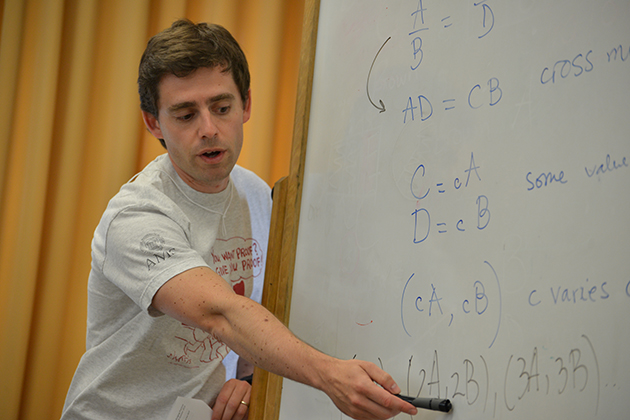
I’m a Professor of Mathematics and my research is in arithmetic geometry (number theory meets algebraic geometry).
Website: https://alozano.clas.uconn.edu/
Office hours: TBA, or by appointment.
Books and Other Resources:
The book for this course is Calculus: Early Transcendentals, 9th Edition.
Homework, Quizzes, Grade, etc:
- This part of the syllabus can be found on HuskyCT.
Outline
Policy Statements:
Please refer to http://provost.uconn.edu/syllabi-references/ for the common policies we follow at UConn.
- Policy Against Discrimination, Harassment and Inappropriate Romantic Relationships — The University is committed to maintaining an environment free of discrimination or discriminatory harassment directed toward any person or group within its community – students, employees, or visitors. Academic and professional excellence can flourish only when each member of our community is assured an atmosphere of mutual respect. All members of the University community are responsible for the maintenance of an academic and work environment in which people are free to learn and work without fear of discrimination or discriminatory harassment. In addition, inappropriate Romantic relationships can undermine the University’s mission when those in positions of authority abuse or appear to abuse their authority. To that end, and in accordance with federal and state law, the University prohibits discrimination and discriminatory harassment, as well as inappropriate Romantic relationships, and such behavior will be met with appropriate disciplinary action, up to and including dismissal from the University. (More information is available at http://policy.uconn.edu/?p=2884.)
- Sexual Assault Reporting Policy — To protect the campus community, all non-confidential University employees (including faculty) are required to report assaults they witness or are told about to the Office of Diversity & Equity under the Sexual Assault Response Policy. The University takes all reports with the utmost seriousness. Please be aware that while the information you provide will remain private, it will not be confidential and will be shared with University officials who can help. (More information is available at http://sexualviolence.uconn.edu/.)
- Attendance — Your instructor expects you to attend class regularly. Besides being nearly essential for developing your understanding of the material, your regular attendance in class is good for the morale of the class and is indicative of your interest in the subject and your engagement in the course. You are responsible for the material discussed in class and in the assigned reading in the text.
- Student Conduct Code — Students are expected to conduct themselves in accordance with UConn’s Student Conduct Code.
- Academic Integrity Statement — This course expects all students to act in accordance with the Guidelines for Academic Integrity at the University of Connecticut. Because questions of intellectual property are important to the field of this course, we will discuss academic honesty as a topic and not just a policy. If you have questions about academic integrity or intellectual property, you should consult with your instructor. Additionally, consult UConn’s guidelines for academic integrity.
- Students with Disabilities — The Center for Students with Disabilities (CSD) at UConn provides accommodations and services for qualified students with disabilities. If you have a documented disability for which you wish to request academic accommodations and have not contacted the CSD, please do so as soon as possible. The CSD is located in Wilbur Cross, Room 204 and can be reached at (860) 486-2020 or at csd@uconn.edu. Detailed information regarding the accommodations process is also available on their website at www.csd.uconn.edu.
- Final Exam Policy — In accordance with UConn policy, students are required to be available for their final exam and/or complete any assessment during the time stated. If you have a conflict with this time you must obtain official permission to schedule a make-up exam with the office of Student Support Services. If permission is granted, OSSA will notify the instructor. Please note that vacations, previously purchased tickets or reservations, graduations, social events, misreading the assessment schedule, and oversleeping are not viable reasons for rescheduling a final.